Facebook
 X
X
 Pinterest
 Copy Link
The Home Buyer’s Red Flag Cheat Sheet: What to Walk Away From vs. What to Negotiate

Buying a home is exciting. It can also make you do things you’d never do with any other purchase, like convince yourself that a little mold in the basement “probably isn’t a big deal.”
You’re not alone. According to a 2026 survey by Clever Real Estate, 76% of home buyers would be willing to overlook red flags in a home. And in some cases, it really isn’t a big deal. Not every red flag means you should run.
The key is knowing which problems are negotiating leverage, which ones need a closer look, and which ones should send you straight back to the car.
Here’s how I break it down for my buyers.
Which red flags are actually opportunities?
Some things that scare off other buyers can actually work in your favor. If you spot one of these, don’t panic, strategize.
A home that’s been sitting on the market.
Almost half of buyers (43%) say a long time on market makes them suspicious. But a home that’s been listed for 60+ days in Windsor usually means one thing: a motivated seller.
That’s your opening to negotiate on price, closing costs, or repairs. Ask me why it’s been sitting; the answer is usually fixable.
A home that fell out of contract.
Only 20% of buyers flag this as concerning, and they’re right not to overreact. Deals fall apart for dozens of reasons that have nothing to do with the house. The buyer’s financing fell through, they got cold feet, or they couldn’t sell their current home.
Cosmetic issues.
Ugly paint, dated fixtures, overgrown landscaping, worn carpet. These scare away buyers who can’t see past the surface.
If you can, you’ll face less competition and often get a better price.
A $5,000 cosmetic refresh on a home you bought for $15,000 under asking? That’s a win.
A prior foreclosure.
Only 24% of buyers see this as a red flag.
By the time a foreclosed home hits the Northern Colorado, the title is typically clean and the bank just wants it sold. These can be some of the best deals in Windsor if you do your due diligence.
Which red flags need a professional opinion before you decide?
These are the ones where the cost can range from “totally manageable” to “walk away.” The difference is almost always in the details, which is why you never skip the inspection.
Mold or water damage.
Here’s a stat that surprised me: 49% of buyers say mold isn’t a dealbreaker. That’s fine, as long as you know the math.
A small patch of bathroom mold might cost $500 to $1,500 to remediate. Mold throughout a crawlspace or behind walls? That’s $10,000 to $30,000.
The mold itself isn’t the dealbreaker. The scope is. Always get a mold specialist’s estimate before you decide.
Foundation or structural problems.
Nearly half of buyers surveyed (45%) would still purchase a home with major structural issues. I get it. In Windsor’s market, you don’t want to lose a home you love.
But the range here is massive: a minor crack might cost $250 to $800 to seal with epoxy. Foundation piering or major stabilization can run $10,000 to $23,000.
Get a structural engineer’s assessment. It costs a few hundred dollars and could save you tens of thousands.
Signs of pests.
A full 57% of buyers say pests aren’t a dealbreaker, and in many cases, they’re right. A standard pest treatment runs a few hundred bucks.
But termite damage is a different story. Repairs for termite damage average $3,000 to $8,000 and can exceed $15,000 if structural elements are compromised.
The treatment is cheap. The repair bill is where it gets expensive.
Electrical problems.
More than half of buyers (54%) would proceed with electrical issues. Minor fixes are routine. But if the home needs a full rewire, you’re looking at $8,000 to $15,000.
Have your inspector flag the panel and wiring type. Knob-and-tube or aluminum wiring is a bigger conversation, because some insurance companies won’t cover it.
Plumbing or water pressure issues.
Another 57% of buyers aren’t deterred by plumbing problems. Low water pressure might just need a new pressure regulator ($200 to $400). But if you’re dealing with corroded pipes, a failing sewer line, or galvanized steel plumbing, a full repipe could cost $4,000 to $15,000.
Which red flags should make you walk away?
These are the ones where no amount of negotiation fixes the problem. The house might be perfect in every other way, but these issues either can’t be resolved or will cost you indefinitely.
Environmental contamination nearby.
The Clever survey found that 59% of buyers would overlook nearby environmental contamination.
That’s concerning. You can renovate a kitchen. You can’t move a Superfund site, a leaking underground storage tank, or industrial runoff.
Check the EPA’s Envirofacts database and Colorado’s environmental records before you fall in love with a property near industrial or commercial zones.
Flood zone without affordable insurance.
More than half of buyers (56%) say a flood zone isn’t a dealbreaker. But flood insurance costs have been rising sharply under FEMA’s Risk Rating 2.0, and in some areas, annual premiums can exceed $3,000 to $5,000 on top of your regular homeowners policy.
Before you make an offer on any property near water or in a low-lying area, check FEMA’s flood maps and get an insurance quote. If the numbers don’t work, neither does the house.
Unresolvable title issues.
Liens from unpaid contractors, boundary disputes with neighbors, unresolved estate claims, undisclosed easements can all delay or kill a closing and haunt you for years after.
Title insurance covers a lot, but it doesn’t cover everything. If the title search turns up complications that can’t be cleared before closing, it’s usually not worth the risk.
A note for first-time buyers
If you’re in your 20s or early 30s buying your first home, this part is for you.
The Clever survey found that younger buyers are significantly more willing to take on serious defects to get into the market. 62% of Gen Z buyers would purchase a home with mold (compared to 40% of boomers). 61% would buy with hazardous materials. And more Gen Z buyers said bad cell phone service is a bigger dealbreaker than cracks in the ceiling.
I understand the urgency. Windsor’s market isn’t easy for first-time buyers, and the pressure to stop renting and start building equity is real. But the most expensive home is the one that costs you $30,000 in repairs six months after closing.
You don’t have to buy a perfect home. You just need to know exactly what you’re buying and what it’ll cost to fix. That’s what I’m here for.
The bottom line
Red flags aren’t all created equal. Some are opportunities in disguise. Some need expert evaluation before you decide. And some should send you looking at the next listing.
The trick is having someone in your corner who knows the difference and who’ll be honest with you even when it means slowing things down.
Winning a Home Offer in Colorado: Tips for Buyers in 2026

If you’re buying a home in Northern Colorado, you’ve probably realized one thing quickly—the best homes don’t sit on the market long.
Even in a shifting market, desirable homes in places like Windsor, Fort Collins, and Loveland can still attract multiple offers. So how do you stand out and actually win the home?
As a local Realtor, I guide my clients through this every day. Here are the exact strategies that help buyers win in today’s market—without overpaying or taking unnecessary risks.
1. Get Fully Pre-Approved (Not Just Pre-Qualified)
One of the biggest mistakes buyers make is thinking a pre-qualification is enough—it’s not.
A full pre-approval shows the seller:
- Your income, assets, and credit have already been verified
- You’re serious and ready to close
- There will be fewer surprises during underwriting
💡 Pro Tip: Work with a local lender. Listing agents trust local lenders more because they know they can close on time.
2. Move Quickly (Speed = Competitive Advantage)
In competitive markets like Windsor and Fort Collins, timing is everything.
Winning buyers:
- See homes within 24–48 hours of listing
- Are ready to write offers immediately
- Don’t “sleep on it” if they love the home
💡 The reality: The longer you wait, the more competition you create.
3. Make a Clean, Strong Offer
A winning offer is not always the highest—it’s the cleanest and most reliable.
Key factors sellers care about:
- Fewer contingencies
- Reasonable deadlines
- Solid earnest money
In Colorado contracts, tightening up:
- Inspection objection deadlines
- Loan availability deadlines
- Appraisal conditions
…can make your offer significantly more attractive.
4. Understand Price vs. Terms Strategy
Winning isn’t always about offering way over asking—it’s about strategy.
You can win by:
- Offering strong price with favorable terms
- Shortening timelines
- Being flexible on possession (huge for sellers!)
💡 Example:
A slightly lower offer with a flexible closing date can beat a higher, rigid offer.
5. Consider an Appraisal Gap (When Appropriate)
In competitive situations, sellers worry about the appraisal coming in low.
An appraisal gap tells the seller:
“I’m willing to cover the difference if the home doesn’t appraise.”
This reduces risk for the seller and makes your offer stronger.
⚠️ Important: Only do this if you fully understand your financial comfort zone.
6. Be Smart With Inspection Requests
Inspections are critical—but how you handle them matters.
Winning buyers:
- Focus on health, safety, and major systems
- Avoid nitpicky repair requests
- Stay reasonable, especially if you already negotiated a great price
💡 This is where having a strong agent matters—we help you prioritize what truly matters.
7. Work With an Experienced Local Realtor
This is one of the biggest advantages you can have.
A strong agent will:
- Communicate directly with the listing agent
- Understand seller motivation
- Position your offer strategically
- Guide you on risk vs. reward
In competitive markets, this can be the difference between winning and losing.
8. Write an Offer That Feels Like a “Sure Thing”
At the end of the day, sellers want certainty.
Ask yourself:
- Does this offer feel easy to accept?
- Does it reduce stress for the seller?
- Does it show we will actually close?
If the answer is yes—you’re in a winning position.
Final Thoughts: Winning Without Overpaying
Winning a home isn’t about throwing money at the deal—it’s about:
- Strategy
- Preparation
- Timing
- Execution
When all of those align, you can win the home you love and feel confident in your decision.
Ready to Buy in Northern Colorado?
If you’re thinking about buying in Windsor, Fort Collins, Loveland, or surrounding areas, I’d love to help you create a winning strategy.
📞 970-213-1895
🌐 lizgrosul.sites.cbmoxi.com
Let’s make sure when the right home comes up—you’re ready to win it.
Living in Water Valley, Windsor CO: What to Expect From This Golf Course Community
Living in Water Valley, Windsor CO: What to Expect From This Golf Course Community



If you’re considering a move to Windsor, Colorado, one community that consistently stands out is Water Valley. Known for its resort-style amenities, mature landscaping, and strong sense of community, Water Valley offers a lifestyle that blends luxury, recreation, and small-town charm.
Whether you’re relocating from out of state or moving within Northern Colorado, here’s what you can expect when living in Water Valley.
Where Is Water Valley Located?
Water Valley is located in west Windsor, CO, just minutes from Fort Collins, Loveland, Timnath, and I-25. Its central location makes commuting easy while still offering a quieter, neighborhood-focused feel.
Residents enjoy:
-
Quick access to Fort Collins and Loveland
-
Proximity to shopping, dining, and schools
-
Easy highway access for regional travel
Types of Homes in Water Valley
One of the most attractive aspects of Water Valley is the variety of homes available.
You’ll find:
-
Patio homes and townhomes
-
Single-family homes
-
Luxury custom homes on golf course lots
-
Homes with lake, mountain, or open-space views
Architectural styles range from classic Colorado designs to modern custom builds. Many homes feature open floor plans, main-floor living options, finished basements, and outdoor spaces designed for entertaining.
Typical home features include:
-
3–6 bedrooms
-
2–5 bathrooms
-
2–4 car garages
-
High-end finishes depending on the section of the neighborhood
Lot Sizes & Neighborhood Feel
Lot sizes in Water Valley vary depending on the area you choose.
-
Patio homes and townhomes sit on smaller, low-maintenance lots
-
Traditional single-family homes offer moderate lot sizes
-
Custom homes often sit on larger lots, especially along the golf course or lakes
The neighborhood is beautifully landscaped with mature trees, walking paths, and open spaces, creating a peaceful, established feel that many buyers are looking for.
Golf Course Living & Golf Cart Lifestyle
Water Valley is home to two highly regarded golf courses, making it a favorite for golf enthusiasts.
One of the biggest lifestyle perks?
Golf cart living.
Residents often:
-
Use golf carts to get around the neighborhood
-
Drive to the clubhouse, pools, or nearby homes
-
Enjoy a relaxed, resort-style atmosphere
Even if you’re not a golfer, the open green space, views, and walkability are major draws.
Lakes, Trails & Outdoor Recreation
Water Valley is known for its lakes and outdoor amenities, which add to the community’s lifestyle appeal.
Residents enjoy:
-
Scenic lakes with walking paths
-
Fishing opportunities
-
Trails throughout the neighborhood
-
Open green spaces and parks
It’s common to see neighbors walking, biking, running, or simply enjoying the outdoors — one of the reasons Water Valley feels so connected.
Amenities & Clubhouse Lifestyle
Living in Water Valley feels like being part of a private resort.
Amenities include:
-
Clubhouse and dining options
-
Community pools
-
Fitness facilities
-
Golf courses and practice areas
-
Year-round community events
- Charter School
- Multiple Parks and beach access
These amenities encourage an active, social lifestyle while still allowing residents to enjoy privacy at home.
HOA vs. Metro District: What You Should Know
Water Valley includes HOAs, and some areas are also part of a metro district.
HOA (Homeowners Association)
HOA fees typically cover:
-
Common area maintenance
-
Landscaping and neighborhood upkeep
-
Community amenities
HOA costs vary depending on the section of Water Valley and the type of home.
Metro District
Some homes fall within a metro district, which helps fund:
-
Infrastructure
-
Roads
-
Community improvements
Metro district taxes are built into property taxes rather than paid monthly. This is an important factor to understand when budgeting, and something I always walk my clients through in detail.
Community Vibe & Lifestyle
Water Valley attracts a wide range of residents, including:
-
Families
-
Professionals
-
Retirees
-
Relocators
The common theme?
People who value community, outdoor living, and quality of life.
Events, social gatherings, and shared amenities make it easy to meet neighbors and feel connected.
Is Water Valley Right for You?
Water Valley may be a great fit if you’re looking for:
-
Golf course or lake living
-
A strong sense of community
-
Resort-style amenities
-
A mix of home styles and price points
-
A central Windsor location
It’s one of Windsor’s most established and desirable neighborhoods — and for good reason.
Thinking About Buying or Selling in Water Valley?
If you’re considering living in Water Valley or want to understand current home values, pricing trends, or which section fits your lifestyle best, having a local expert matters.
I live and work in Northern Colorado and help buyers and sellers navigate Water Valley with clarity, strategy, and confidence.
Let’s make sure you find the right home — and the right fit.
The Tax Benefits of Owning a Home
From Realtor.com:
What are the tax benefits of owning a home? Plenty of homeowners are asking themselves this right around now as they prepare to file their taxes.
You may recall the Tax Cuts and Jobs Act—the most substantial overhaul to the U.S. tax code in more than 30 years—went into effect on Jan. 1, 2018. The result was likely a big change to your taxes, especially the tax perks of homeownership. This revised tax code is still in effect today.
Whatever questions you have, look no further than this complete guide to all the tax benefits of owning a home, where we run down all the tax breaks homeowners should be aware of when they file their 2023 taxes in 2024. Read on to ensure you aren’t missing anything that could save you money!
Mortgage interest
Homeowners with a mortgage that went into effect before Dec. 15, 2017, can deduct interest on loans up to $1 million.
“However, for acquisition debt incurred after Dec. 15, 2017, homeowners can only deduct the interest on the first $750,000,” says Lee Reams Sr., chief content officer of TaxBuzz.
Why it’s important: The ability to deduct the interest on a mortgage continues to be a significant benefit of owning a home. And the more recent your mortgage, the greater your tax savings.
“The way mortgage payments are amortized, the first payments are almost all interest,” says Wendy Connick, owner of Connick Financial Solutions. (See how your loan amortizes and how much you’re paying in interest with this online mortgage calculator.)
Note that the mortgage interest deduction is an itemized deduction. This means that for it to work in your favor, all of your itemized deductions (there are more below) need to be greater than the new standard deduction, which the Tax Cuts and Jobs Act nearly doubled.
And note that those standard deduction amounts increased for the 2023 tax year. For individuals, the deduction is now $13,850, and it’s $27,000 for married couples filing jointly. The deduction also went up to $20,800 for the head of household. And if you’re 65 or older, you can add on an extra $1,850 per person if married and filing jointly or an extra $1,500 if you’re a head of household or a single filer.
As a result of these increased standard deductions, itemizing your deductions may simply not be worth it this filing season.
So when would itemizing work in your favor? As one example, if you’re a married couple under 65 who paid $20,000 in mortgage interest and $6,000 in state and local taxes, you would exceed the standard deduction and be able to reduce your taxable income by an additional $1,000 by itemizing.
Property taxes
This deduction is capped at $10,000 for those married filing jointly no matter how high the taxes are. (Here’s more info on how to calculate property taxes.)
Why it’s important: Taxpayers can take one $10,000 deduction, says Brian Ashcraft, director of compliance at Liberty Tax Service.
Just note that property taxes are on that itemized list of all of your deductions that must add up to more than your particular standard deduction to be worth your while.
And remember that if you have a mortgage, your property taxes are built into your monthly payment.
Energy efficiency upgrades
According to Bishop L. Toups, a taxation attorney in Venice, FL, qualifying solar electric panels and solar water heaters are good for a credit of up to 30% of the cost of the equipment and installation.
And you can also nab an energy-efficient home improvement tax credit of up to $3,200 for improvements made to your home after January 1, 2023. Energy-efficient upgrades include things like exterior windows, doors and skylights, insulation, and the cost of home energy audits.
A home office
Good news for all self-employed people whose home office is the principal place where they work: You can deduct $5 per square foot, up to 300 square feet, of office space, which amounts to a maximum deduction of $1,500.
For those who can take the deduction, understand that there are very strict rules on what constitutes a dedicated, fully deductible home office space. Here’s more on the much-misunderstood home office tax deduction.
The fine print: Unfortunately, if you are a W-2 employee, you’re not eligible for the home office deduction under the CARES Act, even if you spent most of 2023 in your home office.
Home improvements to age in place
To get this break, these home improvements will need to exceed 7.5% of your adjusted gross income. So if you make $60,000, this deduction kicks in only on money spent over $4,500.
The cost of these improvements can result in a nice tax break for many older homeowners who plan to age in place and add renovations such as wheelchair ramps or grab bars in bathrooms. Deductible improvements might also include widening doorways, lowering cabinets or electrical fixtures, and adding stairlifts.
The fine print: You’ll need a letter from your doctor to prove these changes were medically necessary.
Interest on a home equity line of credit
If you have a home equity line of credit, or HELOC, the interest you pay on that loan is deductible only if that loan is used specifically to “buy, build, or improve a property,” according to the IRS. So you’ll save cash if your home’s crying out for a kitchen overhaul or half-bath. But you can’t use your home as a piggy bank to pay for college or throw a wedding.
The fine print: You can deduct only up to the $750,000 cap, and this is for the amount you pay in interest on your HELOC and mortgage combined. (And if you took out a HELOC before the new 2018 tax plan for anything besides improvements to your home, you cannot legally deduct the interest.)
Read more:
Behind the Scenes of a Real Estate Transaction in Northern Colorado: What You Don’t See (But Your Agent Does)

Behind the Scenes of a Real Estate Transaction in Northern Colorado: What You Don’t See (But Your Agent Does)
Most people think real estate is simple. You look at houses.
You write an offer.
You sign some paperwork.
You get the keys. What you don’t see is everything happening behind the scenes – the constant problem-solving, the negotiations, the risk management, the strategy, and the protection happening quietly on your behalf. As a Northern Colorado Realtor, I can tell you this:
The real work in real estate happens where clients never see it. Let me pull back the curtain.
The Part You See vs. The Part You Don’t
What you see:
- Showings
- A “For Sale” sign
- A contract
- A closing day photo
What you don’t see:
- The pricing strategy conversations
- The negotiation chess match
- The inspection battles
- The appraisal stress
- The legal and contractual risk management
- The dozens of calls, emails, and late nights making sure your deal doesn’t fall apart
A good agent isn’t just opening doors. A good agent is protecting you from bad decisions, bad contracts, bad inspections, and bad outcomes.
Behind the Scenes When You’re Buying a Home
When you write an offer, there’s a lot happening in the background:
- Analyzing comps to make sure you don’t overpay
- Structuring your offer to beat competing buyers without overexposing you
- Calling the listing agent to position your offer strategically
- Writing clauses that protect your earnest money
- Making sure deadlines and terms don’t put you at risk
Then comes inspection. This is where deals often live or die. Behind the scenes, your agent is:
- Reviewing inspection reports line by line
- Advising what’s normal vs what’s a red flag
- Negotiating repairs or credits
- Making sure you’re not inheriting major hidden problems
- Protecting your right to walk away if needed
Then comes appraisal, lending, underwriting, title work, timelines, extensions… Your agent is managing all of it so you don’t have to.
Behind the Scenes When You’re Selling a Home
Selling is even more strategic than most people realize. Before your home ever hits the market, a good agent is:
- Studying your neighborhood data
- Analyzing buyer behavior
- Building a pricing and positioning strategy
- Advising on what actually moves the needle – and what doesn’t
Once you’re under contract, the real work starts:
- Managing inspections and negotiations
- Handling appraisal issues
- Protecting your net proceeds
- Making sure deadlines are met so the buyer can’t back out unfairly
- Keeping the deal alive when emotions, financing, or inspections get rocky
Many transactions almost fall apart. Most clients never even know how close it was. That’s not luck. That’s experience.
The Emotional Side Nobody Talks About
Real estate is not just paperwork. It’s:
- Families
- Stress
- Fear
- Big financial decisions
- Big life transitions
Behind the scenes, your agent is also:
- Talking you off the ledge
- Helping you think clearly under stress
- Giving honest advice (even when it’s not what you want to hear)
- Helping you avoid emotional decisions that cost you money
Why Choosing the Right Agent Actually Matters
In a smooth transaction, it can feel like:
“That was easy. Anyone could do that.”
In reality:
The smoother it is, the more work was happening behind the scenes.
The difference between a good agent and a bad one often shows up in:
- Your price
- Your terms
- Your protection
- Your stress level
- And whether the deal even makes it to closing
My Philosophy as Your Realtor
I believe:
- You deserve honest advice
- You deserve strong protection
- You deserve clear communication
- And you deserve someone who treats your transaction like it’s their own money on the line
I don’t take lightly that:
For most people, this is the biggest financial decision of their life.
Thinking About Buying or Selling in Northern Colorado?
Whether you’re:
- Thinking about moving now
- Or six months from now
- Or a year from now
The best first step is a conversation and a strategy. I’m always happy to:
- Walk you through the process
- Show you the numbers
- And help you build a smart, low-stress plan
📞 Call or text: 970-213-1895
📧 Email: liz.grosul@cbrealty.com
🌐 Website: lizgrosul.sites.cbmoxi.com – Liz Grosul
Coldwell Banker Realty | Northern Colorado
Northern Colorado Home Buying Timeline: Why You Should Not Make Big Purchases Before Closing

The Smart Buyer’s Timeline in Northern Colorado: Why You Should NOT Buy Anything During the Home Buying Process
By Liz Grosul, Realtor® | Coldwell Banker Realty | Thrive Realty Collections
If you’re planning to buy a home in Northern Colorado—whether in Windsor, Fort Collins, Loveland, Timnath, or surrounding areas—there’s one mistake that can instantly derail your purchase:
Making a big purchase during the home buying process.
That new truck. The boat. The furniture. The credit card spree at Costco.
Even if you’re already under contract.
Even if you’re “just looking.”
Even if your lender said you were pre-approved.
Let’s walk through a simple buyer timeline and exactly why protecting your credit is critical from start to finish.
Step 1: The Planning Phase (Before You Shop)
What happens here:
- You talk to a lender
- You get pre-approved
- You set your budget
- You start browsing homes online
Important truth: Your pre-approval is based on a snapshot of your finances at that exact moment in time.
Your lender is checking:
- Credit score
- Debt-to-income ratio
- Employment
- Assets
If any of those change — even slightly — your buying power can change.
Step 2: The Shopping Phase (Touring Homes & Writing an Offer)
What happens here:
- You tour homes
- You fall in love with one
- You write an offer
- You go under contract 🎉
Critical mistake buyers make:
“We’re under contract, so we’re good now!”
Not true.
Your lender will re-check your credit before closing.
Step 3: The Under Contract Phase (This Is Where Deals Die)
This is the most dangerous phase for your credit.
During this time you will:
- Do inspections
- Do appraisal
- Finalize your loan
- Prepare for closing
And your lender will:
- Re-pull your credit
- Re-verify employment
- Re-check debts
🚨 DO NOT during this phase:
- Buy a car
- Buy a boat
- Finance furniture
- Open a new credit card
- Co-sign for anyone
- Put big purchases on your credit card
- Change jobs (without talking to your lender first)
Even if your credit score stays high, your debt-to-income ratio can change — and that alone can kill your loan approval.
Step 4: The Closing Phase (The Final Check)
Right before closing, your lender does a final verification.
This is where buyers sometimes hear:
“Your loan is no longer approved.”
And it’s almost always because:
- A new loan showed up
- A credit card balance jumped
- A new payment appeared
Why This Matters So Much in Northern Colorado
In competitive markets like Windsor, Fort Collins, Timnath, Severance, and Loveland, sellers want:
- Clean offers
- Strong financing
- No drama
If your financing falls apart, you can:
- Lose the house
- Lose your inspection money
- Lose your appraisal money
- Potentially lose your earnest money
The Simple Rule
Do not change anything financially from pre-approval until AFTER you close.
If you’re not sure whether something is okay:
- Ask your lender
- Or ask me first
The Ideal Buyer Timeline (Simple Version)
- Talk to a lender
- Get pre-approved
- Hire a great local agent (hi 👋)
- Go shopping
- Get under contract
- Protect your credit
- Close on your home
- THEN go buy the car, furniture, boat, or toys 😄
Why I Coach My Buyers So Closely
I don’t just help you find a home — I help protect the deal all the way to closing.
In Northern Colorado, details matter. Timelines matter. Financing matters.
And one small mistake can cost you your dream home.
Thinking About Buying in Northern Colorado?
If you’re considering buying in:
- Windsor
- Fort Collins
- Loveland
- Timnath
- Severance
- Greeley
- Or anywhere in Northern Colorado
I’d love to help you build a smart, stress-free plan.
Contact Liz Grosul
Liz Grosul
Realtor® | Coldwell Banker Realty | Thrive Realty Collections
📞 970-213-1895
📧 liz.grosul@cbrealty.com
🌐 https://lizgrosul.sites.cbmoxi.com
SEO Metadata (For Your Website)
SEO Title:
Northern Colorado Home Buying Timeline: Why You Should Not Make Big Purchases Before Closing
Meta Description:
Buying a home in Northern Colorado? Learn the exact buyer timeline and why buying a car, furniture, or making big purchases before closing can destroy your loan approval.
Primary Keywords:
Northern Colorado home buying, Windsor CO Realtor, Fort Collins home buyer, mortgage pre-approval tips, home loan credit mistakes, buying a house timeline, Colorado home buying process
Geo Keywords:
Windsor CO real estate, Fort Collins CO homes, Loveland CO real estate, Timnath CO homes for sale, Severance CO real estate, Greeley CO homes, Northern Colorado Realtor
Image Alt Text Suggestions:
- Northern Colorado home buyer timeline graphic
- Liz Grosul Windsor CO Realtor
- Home closing day in Northern Colorado
- Colorado front range homes for sale
What I Do Differently as a Realtor in Northern Colorado

What Sets Me Apart as a Northern Colorado Realtor: What Buyers and Sellers Can Expect When Working with Me
A Modern Approach to Real Estate Rooted in Relationships, Strategy, and Local Expertise
Buying or selling a home in Northern Colorado is more than a transaction—it’s a major life decision. As a Realtor who has spent my entire life in this community and built a career around service, communication, and strategy, my business is built on one core belief: my clients deserve a better experience than the industry standard.
This blog walks you through what I do differently, and exactly what you can expect whether you are preparing to list a home or looking to buy in Northern Colorado.
1. What I Do Differently as a Northern Colorado Realtor
1.1 A Relationship-Driven, Clients-for-Life Philosophy
Most agents disappear after the transaction. I don’t.
My business is built around long-term relationships, ongoing communication, and being a resource for my clients year after year. From vendor referrals to annual market reviews to community events, once you work with me—you are part of my real estate family.
1.2 Strategic Pricing Backed by Local Data
Northern Colorado’s market is hyper-local. Windsor behaves differently than Fort Collins. Severance trends differently than Timnath.
Instead of relying on generic CMAs, I provide:
-
Pricing benchmarks by micro-neighborhood
-
Supply and demand trends
-
List-to-sale percentage analysis
-
Days-on-market forecasting
-
Strategy options (traditional pricing, value-range pricing, market positioning)
This ensures your home is priced to perform, not just priced to list.
1.3 High-End Marketing That Showcases Your Home at Its Very Best
I use a luxury-level marketing system for every property, not only high-end homes:
-
Professional photography and videography
-
Drone and aerial footage
-
Branded property videos and reels
-
Matterport 3D tours
-
Custom listing website + syndication
-
Geo-targeted ads for out-of-state buyers
-
Circle prospecting campaigns
-
Email campaigns to buyers and agents
-
Staging guidance or full-service staging options
Where most agents put your listing on the MLS and hope for the best, I put your home in front of the highest number of qualified buyers — locally, regionally, and nationally.
1.4 Communication That Is Clear, Consistent, and Predictable
You won’t wonder what’s happening with your listing or purchase.
I deliver:
-
Weekly updates
-
Showing feedback
-
Market shifts affecting your price or position
-
Contract-to-close timeline guidance
-
Transparent expectations
You always know the “why,” the “what’s next,” and the strategy behind every recommendation.
1.5 Negotiation Rooted in Experience, Data, and Discipline
As a former competitive athlete and business owner, negotiation is where I excel. You can expect:
-
Calm, firm, strategic communication
-
Creative solutions to protect your interests
-
Data to justify your position
-
Strong contract insights specific to Colorado
My job is to advocate for you, protect your equity, and secure the strongest possible outcome—without drama, ego, or emotion.
2. What Sellers Can Expect When Listing With Me
2.1 A Clear Listing Roadmap
From prep to closing, you receive a structured, step-by-step plan:
-
Pricing strategy
-
Home preparation + staging plan
-
Photo/video production
-
Targeted marketing launch
-
Broker outreach + open houses
-
Offer review + negotiation
-
Contract management
-
Closing + post-close support
No guesswork. No confusion. Just a proven system that works.
2.2 Maximizing Your Net, Not Just Your Price
Selling for a high price means nothing if your net suffers.
I help you make smart, strategic decisions regarding:
-
Concessions
-
Inspection negotiations
-
Timing
-
Appraisal strategy
-
Pre-list improvements with the best ROI
My goal is simple: protect and grow your equity.
2.3 Exposure to the Right Buyers
From golf-course buyers to out-of-state relocators, I understand who is likely to purchase your home and tailor your marketing accordingly.
Your listing never receives a one-size-fits-all approach.
3. What Buyers Can Expect When Working With Me
3.1 A Focus on Education, Clarity, and Confidence
I walk buyers through:
-
Loan options
-
Neighborhood comparisons
-
Resale potential
-
Inspection expectations
-
Offer strategy in a shifting market
Fear comes from the unknown—I eliminate that.
3.2 A Data-Driven Search Strategy
Instead of sending random listings, I tailor your search using:
-
Inventory trends
-
Price-per-square-foot analysis
-
Future development plans
-
School district data
-
Lifestyle preferences (golf, walkability, views, acreage, trails, etc.)
You receive curated properties, not noisy search results.
3.3 Negotiation That Protects You From Overpaying
You will never feel pressured to buy a home that is not the right fit.
If the numbers don’t make sense, or if something feels off, I tell you—and we pivot.
3.4 A Smooth Contract-to-Close Experience
From inspections to appraisal to final walkthrough, I ensure:
-
Every deadline is met
-
Every detail is reviewed
-
No surprises arise at closing
My goal is to make the process feel organized, predictable, and empowering.
4. Why Work With Me: The Core of My Brand
Honesty. Consistency. Service. Discipline.
Real estate is personal. Clients choose me because I combine:
-
Local knowledge
-
Fitness-level discipline
-
Relationship-based values
-
High-end marketing
-
Strategic negotiation
-
Full transparency
And because I care deeply about helping you build wealth and stability through homeownership.
Next step:
If you’re considering buying or selling in Northern Colorado, I would love to guide you.
Reach out anytime for a strategy call, a home valuation, or a personalized buyer consultation.
Contact:
liz.grosul@cbrealty.com
970-213-1895
Website: lizgrosul.sites.cbmoxi.com
The Complete Home Seller Timeline: How to Sell Your Home in Colorado Step-by-Step
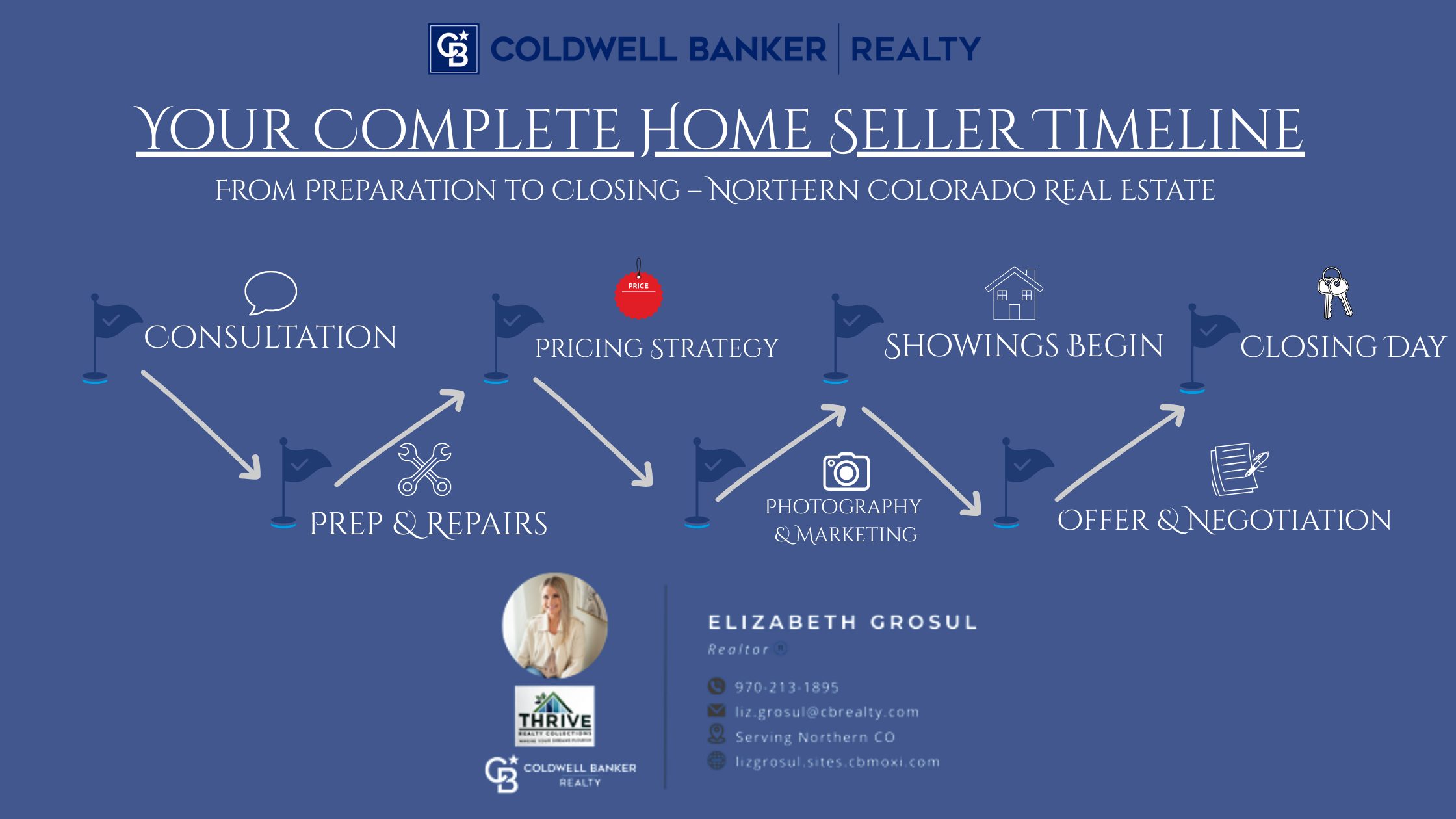
Selling your home is a major financial and emotional decision. Whether you’re moving for lifestyle changes, upsizing, downsizing, or taking advantage of Northern Colorado’s long-term appreciation, understanding the full home-selling process helps you feel confident and prepared.
Below is your complete, start-to-finish Seller Timeline—written specifically for Northern Colorado homeowners and optimized for search engines.
1. Initial Consultation (Week 0)
Every successful sale begins with a strategy session.
During this meeting, we discuss:
-
Your goals, timeline, and motivation
-
Current Northern Colorado market trends
-
A realistic pricing range based on comparable sales
-
Any preparation needed before we list
-
Estimated net proceeds
By the end, you’ll have clarity on the path forward and a customized game plan.
2. Home Walkthrough & Pre-Listing Preparation (Week 1)
This is where we unlock your home’s potential.
I complete a full walkthrough and identify:
-
Repairs
-
Light updates (paint, flooring, fixtures)
-
Items that impact appraisals or inspections
-
Opportunities to increase value
-
Curb appeal improvements
I also give you access to my trusted local contractors, cleaners, stagers, and landscapers.
Pre-list prep typically takes 7–21 days, depending on the home’s needs.
3. Pricing Strategy & Listing Agreement (Week 1–2)
Strategic pricing is one of the most important decisions you’ll make.
I analyze:
-
Micro-market data in Windsor, Fort Collins, Loveland, and surrounding areas
-
Pending sales
-
Active competition
-
Seasonal demand
-
Historic appreciation rates in Northern Colorado
Once we finalize the strategy, we sign the Exclusive Right-to-Sell Agreement and set a go-live date.
4. Professional Photography, Video & Marketing Assets (Week 2)
Buyers shop with their eyes first.
Your marketing package includes:
-
HD photography
-
Drone footage
-
Lifestyle video or reel
-
3D Matterport tour
-
Floorplans
-
A dedicated property website
While media is produced, I build out your full marketing strategy, including:
-
Social media campaigns (Instagram, Facebook, YouTube)
-
Buyer-agent email campaigns
-
Geo-targeted ads
-
Just-listed postcards
-
Database notifications
Your home will look stunning across every major platform.
5. Coming Soon Campaign (Optional but Powerful)
If you want to build buzz before going live, a Coming Soon strategy can help increase:
-
Showings
-
Online activity
-
Early interest
-
Chances of receiving strong opening offers
This pre-launch period lasts 3–7 days.
6. Live on the Market & Showings Begin (Week 3)
Your home goes active on the MLS and syndicates to:
Zillow
Realtor.com
Homes.com
ColdwellBankerHomes.com
And 100+ partner sites
During this phase:
-
Buyers schedule showings
-
We gather feedback
-
We monitor online traffic
-
I provide weekly updates on activity and competition
The first 5–7 days are critical. If priced and marketed well, this is where momentum builds.
7. Offer Review & Strategic Negotiation (Week 3–4)
When offers come in, we evaluate:
-
Price
-
Concessions
-
Loan type (conventional, FHA, VA, cash)
-
Inspection terms
-
Appraisal risk
-
Buyer motivation
-
Closing timeline
-
Contingencies
My negotiation approach focuses on maximizing your net proceeds and ensuring a clean, strong contract that protects you.
8. Under Contract: Inspection, Appraisal & Deadlines (Weeks 4–7)
Once under contract, we move into the due diligence phase:
Inspection
Buyers may request repairs or credits. I guide you through what’s normal, what’s strategic, and what protects your bottom line.
Appraisal
We prepare your appraisal packet to support value. If the appraisal comes in low, I negotiate aggressively on your behalf.
Title Work
HOA docs, seller disclosures, and title commitments are managed to keep us compliant and on schedule.
9. Closing Week (Week 7–8)
Closing is simple and takes about an hour.
This is when:
-
Funds are transferred
-
Title changes hands
-
Keys are exchanged
-
The deed records with the county
Once funded and recorded—congratulations, your home is officially sold.
10. Post-Closing Support (Ongoing)
Most agents disappear after closing. I don’t.
You’ll continue receiving:
-
Market updates
-
Home valuation reports
-
Contractor recommendations
-
Community event invitations
-
Ongoing support for future real estate goals
I’m here long after the ink dries.
Your 2025 Colorado Home Seller Timeline ChecklistReady to Sell in 2025?
If you’re thinking about selling in the next 3–12 months, now is the perfect time to start planning. Reach out for a free Home Equity Report, a customized pricing strategy, or a walkthrough consultation.
I’ll guide you through every step so you can sell confidently and maximize your results.
Contact: liz.grosul@cbrealty.com | 970-213-1895
Website: lizgrosul.sites.cbmoxi.com
Why a Housing Crash Isn’t Coming — And What Buyers Should Really Know Going Into 2026
 Over the past few months, viral charts and dramatic headlines have been predicting a massive collapse in home prices — calling this the “biggest housing bubble in history” and warning of an “inevitable crash.”
If you’ve seen these posts floating around, you’re not alone. Many buyers and sellers have been asking whether they should hold off, wait for prices to drop, or prepare for major market shifts.
But according to top economists (including Brian Wesbury, Chief Economist at First Trust), the data tells a very different story.
Here’s what’s actually happening — and why a housing collapse is highly unlikely.
🏡 1. We Are Not Overbuilding Like We Were in the Early 2000s
The last true housing crash was fueled by massive overbuilding.
During the early 2000s housing boom, U.S. builders were starting nearly 1.9 million homes per year.
Today?
We’re building roughly 1.5 million per year — and even that isn’t enough to meet demand.
We’re still playing catch-up from a decade of underbuilding after the 2008 crash. That shortage continues to support today’s home prices.
🛑 2. Government Policies Limit New Home Supply
Even when builders want to build, they’re up against:
-
Zoning restrictions
-
Environmental regulations
-
Slow permitting
-
“Affordability” rules that ironically make building more expensive
All of this keeps construction limited and drives low inventory, which naturally keeps prices elevated.
Home prices rising due to scarcity is not a bubble — it’s simple supply and demand.
📈 3. The “Bubble” Predictions Aren’t New (or Accurate)
The same analyst predicting a crash today also predicted one in 2019.
Since then?
➡️ Home prices rose 57% nationwide
➡️ Inflation averaged far below housing appreciation
The “bubble calls” haven’t matched reality.
🧠 4. If Homebuilding Stopped, Prices Would Skyrocket — Not Collapse
Imagine if the government banned all new homebuilding.
What would happen?
Prices would explode upward because supply would instantly shrink.
In many ways, we’ve created a mild version of this scenario:
-
Not enough land is available
-
Regulations slow construction
-
Population keeps growing
Less supply + more demand = higher prices.
This isn’t a bubble — it’s structural.
📉 5. Could We See Small Price Adjustments? Yes. A Collapse? Very Unlikely.
Some short-term factors — like immigration policy or seasonal slowdowns — can create temporary dips in pricing or demand.
But a 2008-style collapse? There’s no data pointing toward that outcome.
In 2008, we had:
-
Millions of risky loans
-
Overbuilding
-
Oversupply
-
Loose lending
Today we have:
-
Record-high equity
-
The strongest homeowners in U.S. history
-
Tight lending standards
-
Low inventory
It’s a completely different environment.
🌟 6. What This Means If You’re Thinking About Buying or Selling
For buyers:
Waiting for a big crash isn’t part of any economist’s forecast.
Prices may stabilize or grow modestly, but a huge drop is not expected. Acting sooner often means more negotiating room and less competition.
For sellers:
Demand remains strong — especially for well-maintained homes in good locations.
And even if the overall economy slows, the housing sector is positioned to stay resilient thanks to limited supply.
💡 Bottom Line
A massive U.S. housing collapse is not what the data suggests.
While the broader economy has risks, housing remains one of the most stable sectors thanks to tight supply, strong equity, and normalized lending.
If you’re planning a move in 2026 or simply want clarity on your neighborhood’s trends, I’m always happy to help you navigate the market with real data—not headlines.
Moving to Windsor, Colorado: What to Expect and How to Get Prepared
🏡 Moving to Windsor, Colorado: What to Expect and How to Get Prepared

Water Valley Neighborhood
If you’re considering a move to Windsor, Colorado, welcome! You’re about to discover one of Northern Colorado’s most charming and fast-growing communities — a place that blends small-town warmth with modern amenities, stunning mountain views, and an unbeatable quality of life.
As a local Realtor who lives and works right here in Windsor, I’ve helped many families make the transition smoothly. Here’s what you can expect — and how to prepare for your move.
🌤️ What Makes Windsor So Special
Windsor sits perfectly between Fort Collins, Loveland, and Greeley, giving you easy access to major employers, shopping, and entertainment while still maintaining that friendly, community-oriented feel.
You’ll find beautiful neighborhoods like Water Valley, Raindance, and Bison Ridge — many featuring golf courses, lakes, and walking trails. Families love the top-rated schools, the recreation center, and year-round community events like Windsor Harvest Festival, Summer Concerts at Boardwalk Park, and 4th of July fireworks over the lake.
For outdoor lovers, there’s no shortage of options — Windsor Lake, Poudre River Trail, and nearby golf courses make staying active easy.
🏠 The Housing Market
The Windsor real estate market offers something for everyone — from cozy condos and newer townhomes to luxury golf-course properties and custom ranches.
As of late 2025, Windsor homes have a median list price around $700K, with new construction and resale options throughout the area. Whether you’re buying or selling, it’s important to have a Realtor who understands Windsor’s micro-markets — prices can vary dramatically between neighborhoods and even between sides of the same street depending on amenities, lot size, and school district.
🧳 How to Prepare for Your Move
1️⃣ Get Pre-Approved Early
If you’re buying, meet with a trusted lender before your home search. Windsor homes can move quickly, especially those near golf courses or lakes. Having your pre-approval letter in hand gives you a strong advantage.
2️⃣ Research Neighborhoods
Each area in Windsor has its own personality —
-
Water Valley offers resort-style living with private lakes and golf.
-
Raindance blends farm-to-table charm with fun amenities like a lazy river and orchards.
-
Bison Ridge and Highpointe Estates offer larger lots and mountain views.
I always recommend exploring in person if you can — grab a coffee at Coffee House 29, take a walk around Boardwalk Park, and get a feel for the community.
3️⃣ Budget for Metro Districts and HOAs
Many newer Windsor communities are part of Metro Districts, which means you’ll pay an additional property tax in exchange for neighborhood amenities and infrastructure. Make sure you understand those costs before you buy.
4️⃣ Prepare for All Four Seasons
Windsor gets sunshine almost year-round but also experiences classic Colorado weather — warm summers, crisp falls, snow in the winter, and plenty of spring wind! Have snow gear handy and keep your patio furniture anchored.
5️⃣ Line Up Local Resources
Before moving, schedule your utilities, trash, and internet. Local favorites include Poudre Valley REA, Xcel Energy, and TDS Fiber. You’ll also want to connect with local service providers — painters, landscapers, or cleaners. (I’m happy to share my trusted vendor list!)
💡 Insider Tips from a Local
-
Plan for growth. Windsor is expanding rapidly, which means new schools, parks, and shopping centers are on the way — great for long-term value.
-
Explore beyond Main Street. Don’t miss the breweries, family-run restaurants, and farm markets that make Windsor feel special.
-
Get involved! Join a local fitness class, volunteer at a school, or attend Friday Night Concerts at the lake — it’s the best way to meet your new neighbors.
❤️ Final Thoughts
Moving to Windsor is more than a relocation — it’s an upgrade in lifestyle. You’ll find friendly neighbors, scenic beauty, and a strong sense of community that’s hard to beat.
If you’re thinking about making Windsor your new home, I’d love to be your local resource. From exploring neighborhoods to helping you settle in, I’ll guide you every step of the way.
Liz Grosul | Coldwell Banker Realty
🏠 Thrive Realty Collections
📞 970-213-1895
📧 liz.grosul@cbrealty.com
🌐 lizgrosul.sites.cbmoxi.com
📱 @grosulsellshomes